
A JUST Transition for Our Climate Crisis
Written by Jason Chow
We are going to have to rethink the way we do pretty much everything to get ourselves out of this climate crisis. Why not use this opportunity to help solve some of our other huge problems like inequality and injustice? This is the idea behind the JUST transition: create a more equitable future while transitioning to a sustainable way of living. But what is the JUST transition, and how can you apply its ideas in your own life?
Origins
The idea behind a JUST transition came from two groups: environmental justice groups and labor unions. The environmental justice movement recognized that low-income communities of color are often the most affected by pollution and climate change, even though they aren’t the ones who caused this crisis. On the labor side, decarbonizing the economy would put some workers out of a job. Without giving these workers pathways to a different livelihood, entire communities will be left out in the cold.
Thanks to a tremendous amount of grassroots work, we have organizations like the World Bank and UN Global Compact incorporating the ideas of a JUST transition to ensure that everyone thrives when we make the necessary changes to our society.
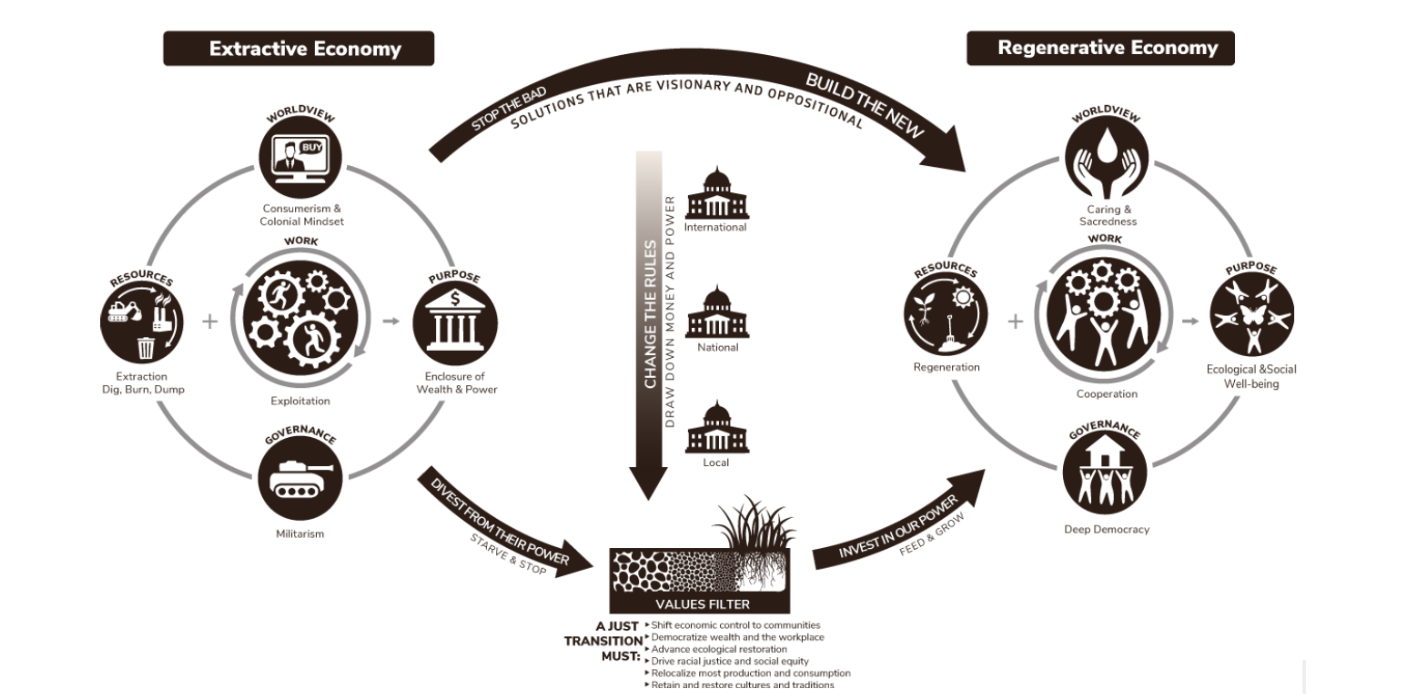
How we can move from the old system to the new (Climate Justice Alliance, 2025)
Key Ideas of a JUST transition
Democratic Decision Making
One of the most important pillars of a JUST transition is to have more democratic decision-making. Elites make big decisions about climate and the economy with very little input from the people they are trying to help. Beyond just being uninclusive, making decisions in a silo can very easily lead to bad outcomes because not all of the consequences were considered. Decisions to put profit over the planet’s health and over people’s basic needs have gotten us into the mess we’re in today. If we give disenfranchised people back some of their agency they can help lead us to a more sustainable future.
Community Rights > Individual Rights
A common theme of the JUST transition is that community rights need to be put over individual rights. Most Western societies elevate individualism over everything else, but no one person should be allowed to do whatever they want. We have to start putting setting some healthy boundaries. For example, if someone owns the water rights in a community, they shouldn’t be allowed to use it for their own purposes if people are living nearby without guaranteed access to fresh water. The rights of the many should outweigh the rights of the few.
Buen Vivir
Another key concept of the JUST transition is Buen Vivir, meaning that people can live well without doing so at the expense of others. Extraction of natural resources and exploitation of labor have powered the lifestyles of those in the Global North at the expense of those in the Global South. Everyone has the right to live a good life and it’s very possible to achieve this without harming others or the environment.
Reimagine the Economy
To live the value of Buen Vivir, a JUST transition must reimagine our economy. Profit-first thinking created our climate crisis and did a lot of damage to communities that had no way to fight back. We can solve two problems at once by reorganizing the economy to prevent further harm to the planet and the people who live here. The new system will have to redistribute resources and power to those that our current system has left behind.
One solution could be adopting the Donut Economics framework which covers the ideas of a JUST transition really well. It redefines the goal of our economy from profit to satisfying everyone’s basic needs. It also includes planetary health constraints to make sure we won’t destroy our home. If we adopt a framework like Donut Economics, we can start to build a truly healthy future for our planet and its people.
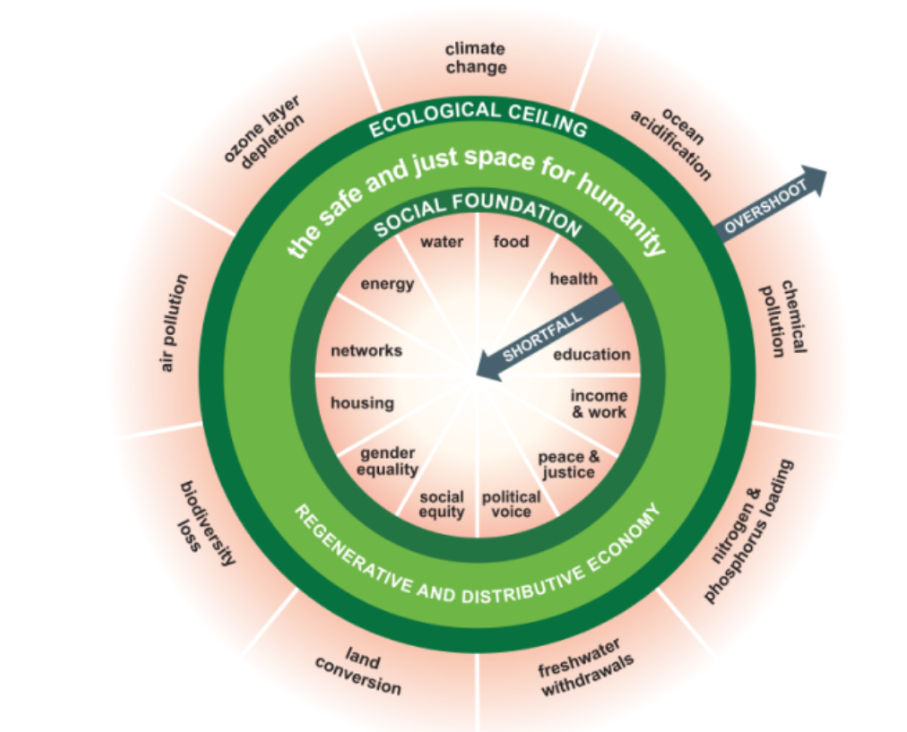
The green donut is where we need to be (Donut Economics Action Lab, 2025).
How can you apply the ideas of the JUST transition?
Without action, ideas aren’t very useful. Now that you’re familiar with the core ideas of the JUST transition, how can you apply them in your life?
1. Bring People In
Start by intentionally bringing a wider range of people into conversations, especially when it comes to climate or sustainability decisions. Even better, put them in a position to make decisions themselves. Their ideas and perspectives might surprise you! As we transition to a more sustainable future, everyone should have a say in what that future might look like.
2. Practice Buen Vivir
Figure out where you or your company could be having a negative impact on the planet or on other people. Do you use lots of single-use plastic that will likely end up in a landfill? Could your product’s ingredients be coming from a poorer country that’s using a lot of its resources to produce them? Once you’ve found your biggest areas for improvement, you can start to make changes and monitor their effects.
3. Live Like the Economy Has Already Been Reimagined
Changing capitalism will be incredibly hard and won’t happen overnight. That’s why it’s up to us to find ways to create the change we want to see in our own lives. The next time you’re in a meeting and a decision is being made, try supporting the option that won’t make the most profit, but is better for the planet, workers, or communities. It’s not easy to go against the system, but you’ll find that most people would agree with you and are just scared to speak up. Even if you don’t succeed, you might inspire someone else to do the same thing later on!
If we play our cards right and truly live the ideas of the JUST transition, we might be able to solve the climate crisis and create a healthier society all at once. But we must act now. The longer we wait, the more urgent climate action will become, and urgency creates the conditions for injustice. Start creating the future you want to see, today!
About the Author
Jason Chow is an Advocacy and Education Fellow at Nu Data. He previously worked as a healthcare data analyst and currently serves as the Digital Director for WorkFour, a nonprofit dedicated to advancing the 4-day workweek. If you have any questions about this article or would like to talk more, you can connect with Jason on LinkedIn.
References
Climate Justice Alliance. (n.d.). JUST transition. Retrieved February 6, 2025, from https://climatejusticealliance.org/just-transition/
United Nations Development Programme. (n.d.). What is a JUST transition and why is it important? Climate Promise. Retrieved February 6, 2025, from https://climatepromise.undp.org/news-and-stories/what-just-transition-and-why-it-important
World Resources Institute. (n.d.). About JUST transitions. Retrieved February 6, 2025, from https://www.wri.org/just-transitions/about
Doughnut Economics Action Lab. (n.d.). About Doughnut Economics. Retrieved February 6, 2025, from https://doughnuteconomics.org/about-doughnut-economics
World Bank. (2021, September 13). Climate change could force 216 million people to migrate within their own countries by 2050. Retrieved February 6, 2025, from https://www.worldbank.org/en/news/press-release/2021/09/13/climate-change-could-force-216-million-people-to-migrate-within-their-own-countries-by-2050