
Impact on Crops: Coffee
Written by Polina Kurdiuk
Crops are critically important for the food supply, especially the ones grown in the United States. U.S. farms supply nearly 25% of all grains around the world. However, changes in temperature, atmospheric carbon dioxide (CO2), and the frequency and intensity of extreme weather can have a bad impact on crops.
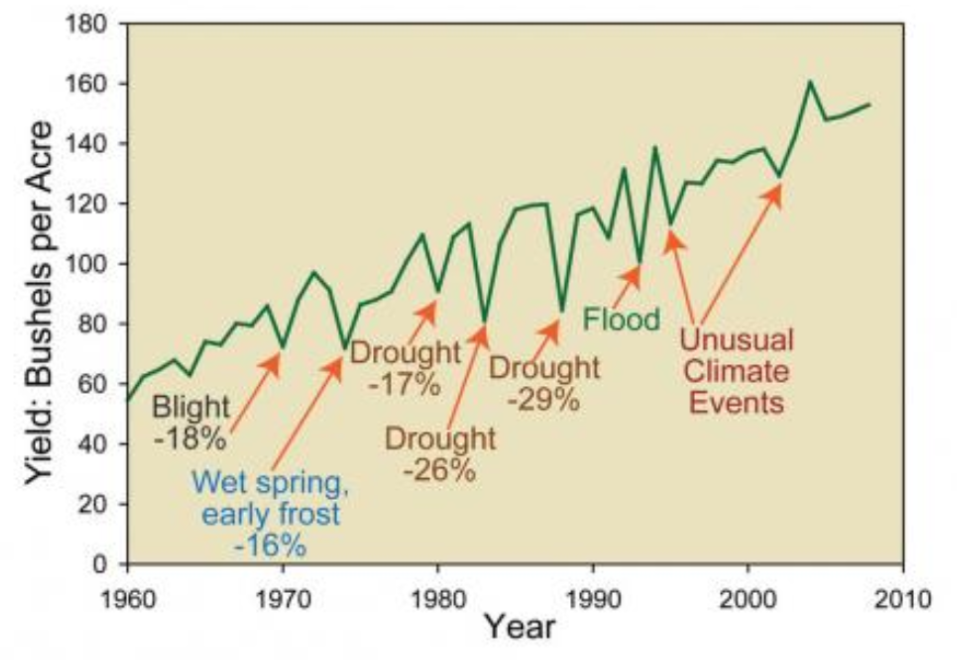
Despite technological improvements that increase corn yields, extreme weather events have caused significant yield reductions in some years.
Rising temperatures may not affect every crop, since different crops have their own perfect temperature for growth. Some crops would feel perfectly fine in warm regions, while for other crops warmth can be harmful.
Higher CO2 levels can increase some plants’ growth. But of course, changing temperatures, ozone, water, and nutrient constraints may be the reason for increased yield.
Extreme temperatures can be an obstacle to the healthy growth of crops. Yields can be reduced due to extreme floods and droughts. As an example, in 2010 and 2012 high nighttime temperatures affected corn yields across the U.S.
While irrigation may be an option for some areas, water scarcity will pose a challenge in others. The rising summer temperatures will dry out the soil and increase the need for irrigation, but the water supply will also be reduced.
Coffee
Coffee farmers in Corquin, Honduras, have seen what climate change did to plantations. Coffee trees were exposed to direct sunlight, rising temperatures were badly affecting plants and decreasing yields.
Many people love coffee, and its production has increased by nearly 40% since 2010 and should double or even triple by 2050. Amazing, right? Unfortunately, it’s not that simple. Coffee cultivation has many problems. The average coffee farmer in Africa and Latin America is above 50 years. Even if coffee is highly priced, farmgate prices are very low and farmers have little power in the supply chain, which leads to economic instability for coffee farmers.
On top of this, climate change impacts coffee production as well. Some studies say its impact is insignificant, others suggest that coffee pests and diseases will rise and coffee yield and quality will decline. New regions, that could potentially be places for coffee growth, are often still covered by forests. Removing so many trees is not a good idea at all.
Coffee is greatly demanded by consumers around the world. However, coffee supplies have decreased, while consumers’ demands have increased.
Indonesia is one of the world’s biggest coffee producers, which mainly produces a lot of Arabica coffee, better known as Gayo Arabica coffee (GAC).
The quality and yield of coffee are greatly influenced by climate and soil conditions. While many studies have proven that altitude affects coffee quality, its impact on coffee yield has been inconsistent and unclear. This inconsistency can be attributed to the biennial cycle, due to which coffee yield naturally fluctuates from year to year.
The phenotypic performance of biennial plants is related to genetic factors, but can also be influenced by environmental stress. Biophysical environmental factors such as altitude and production year are hypothesized to affect both the yield performance and stability of the three GAC cultivars. This is because biennial plants are more prominent in Arabica coffee than in Robusta coffee, and environmental stress can impact their phenotypic performance.
Farmers
Food security means that all people always have physical, social, and economic access to enough safe and nutritious food to live an active and healthy life. Including food availability, food access, and how food is utilized. Small-scale coffee producers have smaller lands and it’s harder for them to maintain a sustainable livelihood. Not to mention high levels of initial capital investments. To add up, they live in weak trade positions countries.
Coffee prices get higher in the international market, making traditional coffee-growing farmers increase their production. It leaves fewer areas for growing food. Exporting coffee promises a better life and an escape from poverty.
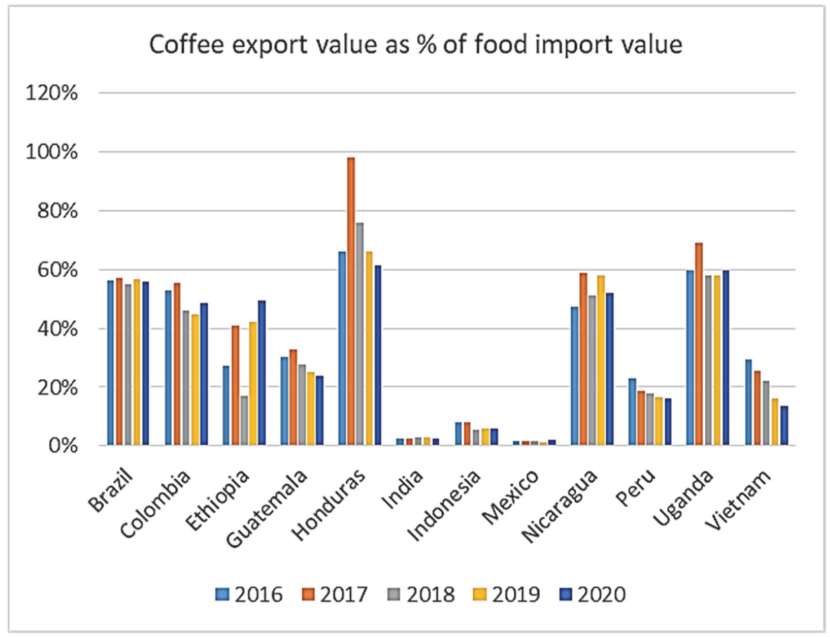
Coffee export revenues as % of food import expenditure, 2016–2020 (FAO-TCL. FAOSTAT Database, Trade Indicators. 2022.
Coffee export revenues as % of food import expenditure, 2016–2020 (FAO-TCL. FAOSTAT Database, Trade Indicators. 2022.
Coffee export revenues as % of food import expenditure, 2016–2020 (FAO-TCL. FAOSTAT Database, Trade Indicators. 2022. Available online: https://www.fao.org/faostat/en/#data/TCL (accessed on 1 June 2022).)
Many smallholder coffee farmers prioritize coffee production over subsistence food production, hoping to earn additional income to purchase food. Isolated rural areas where the world’s best coffee is grown are exposed to multiple food insecurity risk factors like environmental degradation, seasonal changes in food production and food prices, and natural disasters. Coffee farmers have to face unstable green bean coffee prices, which increases food vulnerability.
Sources
Nature. "Long-Term Effects of Intensive Agriculture on Soil Health." Scientific Reports, 8, Article number: 6116, April 12, 2018.
Healthline. "GMO Pros and Cons: The Science Behind the Debate.", April 7, 2021.
Forbes. "Why Soil Health Matters More Than Ever.", December 7, 2016.
MDPI. "Coffee Yield Stability as a Factor of Food Security." Foods, vol. 11, no. 19, 2022.
De Gruyter. "Yield Performance and Stability Analysis of Three Cultivars of Gayo Arabica Coffee Across Six Different Environments." Open Agriculture, vol. 7, no. 1, 2022.
Coffee Bridge. "Coffee: An Important Cash Crop in Global Trade."
Greenly. "Is Coffee Threatened by Climate Change?", May 3, 2024.
Author’s Hot Take
Coffee, and crops in general, are in big trouble. And guess what? It’s climate change.
Weather, droughts, floods, rising temperatures - everything’s all over the place. Coffee farmers are already struggling with low yields but demand for coffee only keeps rising, which is understandable. When big-scale farmers may have resources to adapt, small-scale farmers are struggling the most. And on top of this, big companies still want to buy coffee for the lowest price. All these changes not only affect crops but also people who grow them and depend on this income to support their families.
We need to pay attention to climate change, again, and its effects on food supplies. If you think it’s not connected to you, well, you’re kinda wrong. Climate change affects crops, there is less food to harvest, meaning less food reaches markets. Less food - high prices. It affects businesses, grocery stores, and all of us. By the way, prices are going up already, especially for coffee all over the world. It’s not even only coffee. Corn and rice are also at risk. So this time climate change is not only about higher temperatures - it’s about whether there’s enough food for us.