Planetary Boundaries and Why They Matter
Written by Jason Chow
Understanding Earth’s Limits
In 2009, a collaboration between the Stockholm Resilience Centre and many renowned scientists introduced the concept of planetary boundaries. The framework outlines 9 of the most important indicators and processes that keep Earth’s systems in balance. Their initial study showed three of those boundaries had been crossed. Then in 2023, they did a follow-up study and the results were alarming. We’ve exceeded six of the nine planetary boundaries (Stockholm Resilience Centre, 2023).
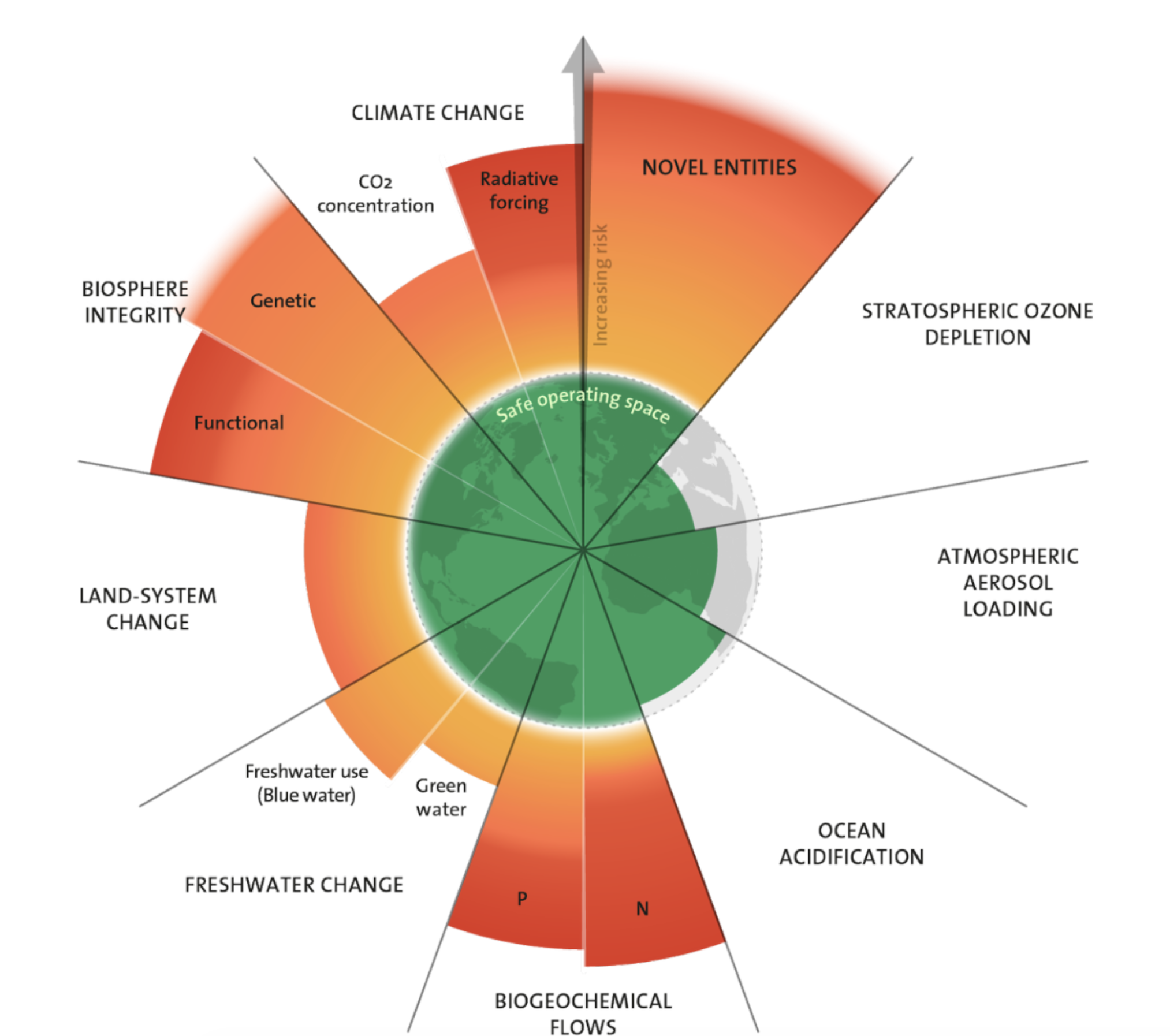
Only 3 planetary boundaries are within the safe zones (Stockholm Resilience Centre, 2024).
It’s getting harder and harder to ignore these results because the effects frequently show up in our lives. Things like extreme weather events or degrading ecosystems highlight that climate change isn’t the whole story. Of course it’s important, but what about the mountains of plastic choking our oceans? Or freshwater supplies vanishing before our eyes? We’ve ignored questions like these for too long and now we’re paying the price. We’ve gone from 3 boundaries crossed in 2009 to 6 crossed in 2023.
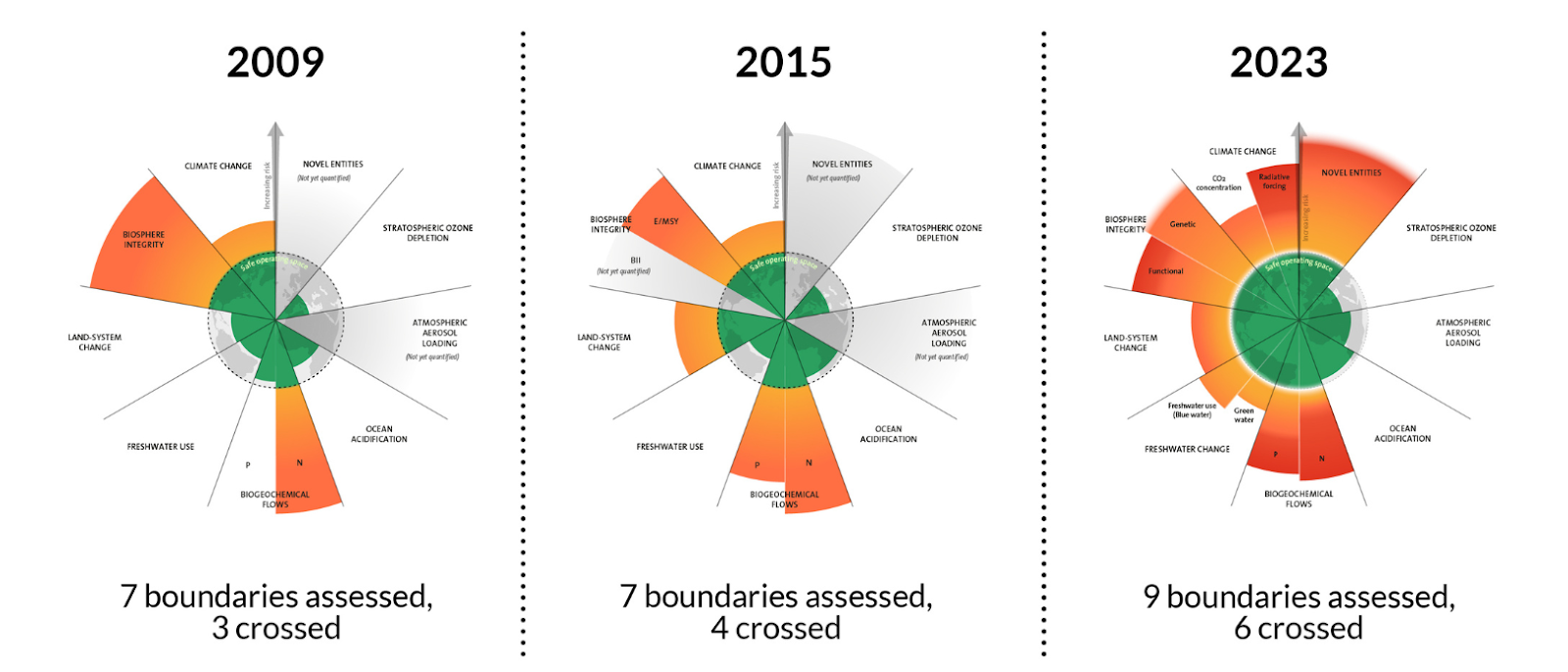
Boundaries are being crossed at an alarming rate (Stockholm Resilience Centre, 2024).
Thankfully, global institutions like the United Nations and the World Economic Forum are starting to understand the significance of planetary boundaries and are including the framework’s principles in their work. For example, the World Economic Forum’s 2024 Global Risks Report highlights critical changes in Earth’s systems and biodiversity loss as two of the most pressing climate risks. We’ll need more holistic systems thinking like this to respond to our climate crisis.
The 9 Planetary Boundaries
Climate Change: We all know this one. Excess greenhouse gases and aerosols disrupt Earth’s energy balance, trapping heat, raising global temperatures, and altering climate patterns. This boundary has been crossed.
Novel Entities: Did you hear about the study showing microplastics in the bloodstream of 80% of the participants? Synthetic chemicals, microplastics, and genetically modified organisms are being introduced into the environment faster than we can assess their long-term impacts. This boundary is way beyond safe limits.
Stratospheric Ozone Depletion: The ozone layer is recovering thanks to a (rare) coordinated global effort. It’s still below its mid-20th-century levels but within the safe operating space.
Atmospheric Aerosol Loading: Things like burning fossil fuels and wildfires release tiny particles that influence temperatures and precipitation. These remain within safe limits globally but have significant regional effects.
Ocean Acidification: Carbon isn’t just going into the atmosphere, it’s also disrupting marine ecosystems. Although within the safe zone, this boundary is approaching critical levels.
Biogeochemical Flows: We’re using too many fertilizers, namely nitrogen and phosphorus, to grow our food and it’s thrown natural nutrient cycles out of balance. The levels of both of these elements are far beyond safe limits.
Freshwater Change: We’re disrupting both blue water (rivers and lakes) and green water (soil moisture) systems, threatening biodiversity and water security. This boundary has been exceeded.
Land-System Change: There’s almost no place left on Earth we haven’t bent to our will for consumption, agriculture, or housing. Humans have thrived, but we’re weakening ecosystems and reducing natural carbon stores. This boundary has been crossed.
Biosphere Integrity: We’re losing species of plants and animals at an alarming rate and its undermining Earth’s ability to regulate life-supporting systems. This boundary is critically exceeded.
The Interplay of Global Systems in Planetary Boundaries
Humans live on Earth. Humans make up a society. Society makes systems. And systems have a huge influence on planetary boundaries, for good or bad. Let’s dive into a few systems to better understand how they work.
Environment
All planetary boundaries are deeply connected. Crossing one boundary will set off a chain reaction that will affect others. Take the palm oil industry for example. Tropical rainforests are being cleared to plant palm trees (land-system change) which disrupts ecosystems (biosphere integrity), reduces rainforest carbon storage potential (climate change), and drains freshwater supplies (freshwater change). Disruptions like these are driving catastrophic biodiversity loss. A UN-backed study by the IPBES recently found that over 1 million species are now at risk of extinction (IPBES, 2022). It’s all connected—and that’s why every decision from every person matters.
Economy
For decades, profits and GDP have been the go-to measure of success, but they don’t fully account for the health of our planet (or for that matter, many other social costs). Companies want to maximize profits and they’ll do that by externalizing as many costs as possible. Take industries that pollute rivers or deplete forests for example. The profits are theirs, but communities still have to live in those damaged ecosystems. This business model is mostly used in the Global South where they can take advantage of lax regulations and pass costs onto vulnerable populations. But industry is starting to wake up. The World Economic Forum raised the alarm with a study showing a potential 16-22% loss in GDP under business as usual (Boston Consulting Group, WEF, n.d). But it is a bit ironic that the metric that got us here is being used to justify change. We can do better.
We desperately need to reframe what profit and wealth really mean. Wealth isn’t just monetary, it’s also having access to clean water and physical safety. That’s why new frameworks like Doughnut Economics are shifting the focus to balance growth, human well-being, and planetary health. Widespread adoption of a framework like this will likely be necessary if we’re going to stop crossing planetary boundaries.
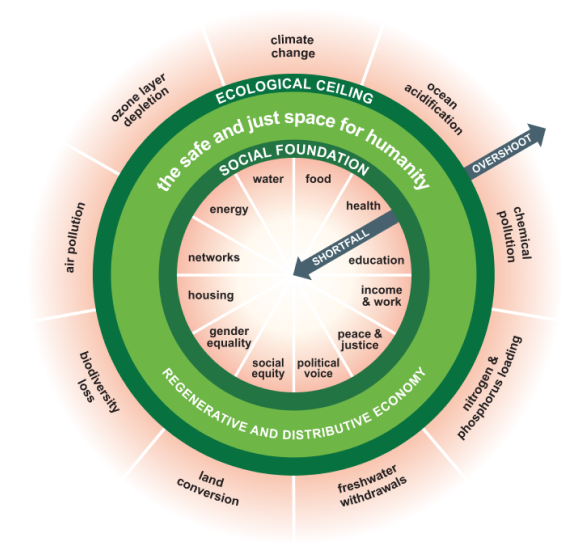
The green donut is where we need to be (Donut Economics Action Lab, 2024).
Society
Cultural norms play a massive role in all this. Take plastic waste, for example. We prioritize convenience over sustainability, leading to 400 million tons of plastic being produced every year (UNEP, 2021). Most of that plastic ends up in landfills immediately after being used. And if you remember the graphic from earlier, the novel entities boundary that encompasses plastic usage is the furthest from the safe zone. So what comes first, demand or product? It’s a real chicken or egg problem. Of course we want to make our lives easier, but companies probably shouldn’t be allowed to sell us products that will harm the environment. There are already rules to prevent them from selling things that will harm us, but we just have to take another step forward and remember the planet is also us.
Short-sighted decisions are having very real effects on our communities. The World Bank’s Groundswell Report estimates that roughly 216 million people could become climate refugees within their own countries by 2050 (World Bank, 2021). This isn’t just about saving the planet; it’s about saving ourselves.
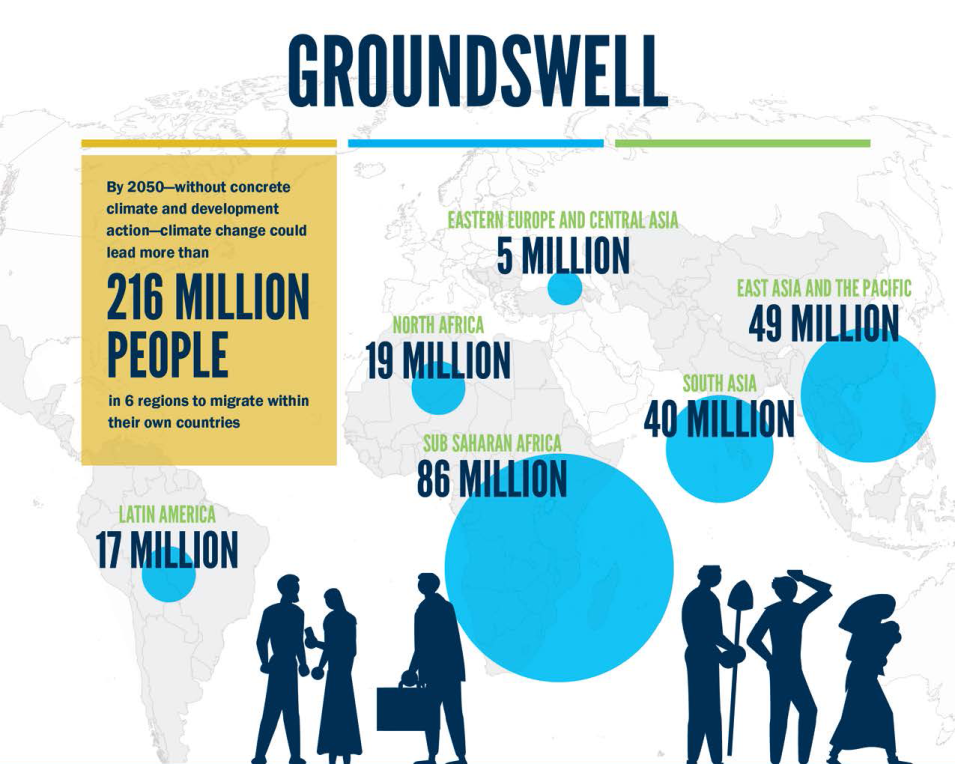
Climate migration within countries will be a huge issue (World Bank, 2021).
How can organizations use the Planetary Boundaries framework?
The planetary boundaries framework highlights that addressing climate change alone isn’t enough. Because Earth’s systems are interconnected, ignoring one boundary while addressing another can lead to unintended consequences. This simple fact has led to positive changes, such as the UN integrating the boundaries into their sustainable development goals (SDGs). Other organizations must follow suit and adopt a holistic approach to ensure their operations respect our planet and can adapt to an uncertain future.
Understand Your Organization’s Footprint Every part of your operation impacts the planet, from manufacturing to product design. Try mapping the impacts of each area across all nine boundaries. Does your supply chain depend on water in drought-prone areas? Are your raw materials sourced in ways that harm ecosystems? Figuring out where you stand is the first step to getting better.
Adopt Meaningful Metrics Cutting carbon is desperately needed, but it’s not the whole picture. Be sure to track any and all metrics relating to planetary boundaries such as total freshwater usage across your supply chain, percentage of raw materials coming from depleted ecosystems, or the amount of plastic used in your packaging. Measuring things along the planetary boundaries framework helps ensure you’re solving problems holistically—not just shifting the burden elsewhere.
Be Flexible and Stay Up to Date
Science evolves, and so will the planetary boundaries framework. It’s not about having all the answers today; it’s about being adaptable. Be sure to follow organizations like the Stockholm Institute and Planetary Health Check Regularly measure your impact, tweak your strategies, and be ready to pivot as needed.
Where do we go from here?
Let’s reset our relationship with our planet. We’re not separate from the Earth and we need to start making decisions that reflect that reality. The planetary boundaries framework isn’t just an academic concept. It’s a roadmap for building systems that work for both people and the planet. We need to ditch short-term thinking and start building a future where we can thrive along with our planet. Every choice we make today shapes the world we’ll pass on to future generations. Let’s make those choices matter!
About the Author
Jason Chow is an Advocacy and Education Fellow at Nu Data. He previously worked as a healthcare data analyst and serves as the volunteer Digital Director for WorkFour, a nonprofit dedicated to advancing the 4-day workweek. If you have any questions about this article or would like to talk more, you can connect with Jason Chow.
References
United Nations Environment Programme. (2021). Drowning in plastics: Marine litter and plastic waste – Vital graphics. UNEP. Retrieved January 13, 2025, from https://www.unep.org/resources/report/drowning-plastics-marine-litter-and-plastic-waste-vital-graphics
Boston Consulting Group. (n.d.). The cost of inaction: A CEO guide to net zero. Retrieved January 13, 2025, from https://www.bcg.com/about/partner-ecosystem/world-economic-forum/ceo-guide-net-zero#the-cost-of-inaction
Intergovernmental Science-Policy Platform on Biodiversity and Ecosystem Services. (2022, July 8). IPBES Sustainable Use Assessment - 50,000 Wild Species Meet Needs of Billions Worldwide. Retrieved January 13, 2025, from https://www.ipbes.net/media_release/Sustainable_Use_Assessment_Published
Stockholm Resilience Centre. (n.d.). Planetary boundaries. Retrieved January 13, 2025, from https://www.stockholmresilience.org/research/planetary-boundaries.html
World Bank. (2021, September 13). Climate change could force 216 million people to migrate within their own countries by 2050. Retrieved January 13, 2025, from https://www.worldbank.org/en/news/press-release/2021/09/13/climate-change-could-force-216-million-people-to-migrate-within-their-own-countries-by-2050